I Used to Know How to Spell
I was trying to teach my teenager how to write a proper high school essay when he looked up and asked, almost casually, “Why can’t I just use ChatGPT?”
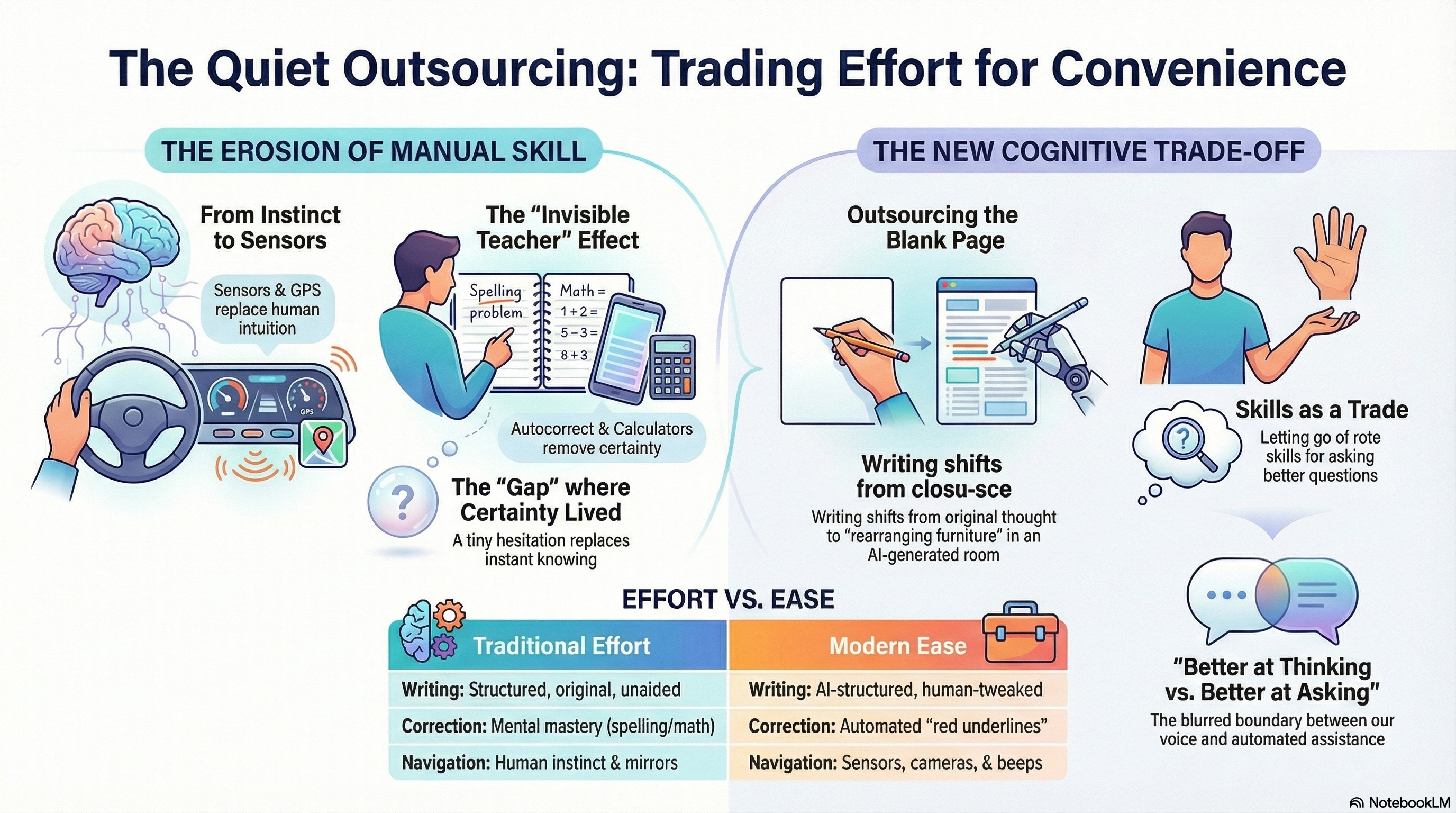
I started to answer, then stopped. Not because I didn’t have opinions, but because none of them felt entirely convincing. Our schools still expect essays written the old way—structured, original, unaided. They grade for individual effort, for clarity of thought, for something we still call “your own voice.” And yet, sitting there across from him, I found myself thinking: are we preparing our kids for a world that has already moved on?
It’s the same feeling I get when I try to teach him driving. He uses the rear-view camera, the parking sensors, the gentle beeps that tell him how close he is to the curb. He parks smoothly, almost effortlessly. Meanwhile, I’m explaining angles and mirrors and that subtle human instinct of knowing when to stop—something I still struggle to describe, let alone teach. He listens, politely, but I can tell he’s not entirely convinced he needs it.
And I can’t quite tell if he’s wrong.
Later, I sat down with a cup of coffee and opened my laptop, intending to write something simple—maybe even prove to myself that I still could. The coffee went lukewarm before I noticed. A thin film formed on top, the way it does when you forget it exists for just a little too long. On the screen, a half-formed sentence waited for me, uncertain and slightly awkward.
I stared at it, then at my phone, then back again. Somewhere in between, I had asked an AI tool to “help structure my thoughts.” It gave me something neat, well-formed, and oddly confident. Too confident, maybe. I hovered over the keyboard, wondering if I still knew how to get from one sentence to the next without assistance, the way I used to do without thinking.
It reminded me of spelling. I used to know how to spell “necessary” without pausing. Now I type it wrong on purpose and wait for the red underline to correct me, like a small, invisible teacher who never gets tired. Calculators did the same thing to my arithmetic years ago. I can still add, subtract, divide—but there’s a hesitation now, a tiny gap where certainty used to live.
None of this feels dramatic. It’s just… quieter. A slow outsourcing of effort.
We don’t argue with convenience for long. We adjust, then defend it, then forget we ever did things differently.
We’ve all agreed, more or less, that convenience is good. Automatic transmissions, autopilot in planes, GPS instead of folded maps that never quite go back the way they came. Each step makes sense when you look at it closely. Each one saves time, reduces effort, smooths out the rough edges.
So it feels slightly ironic that writing—simple, everyday writing—is where we hesitate.
I read recently that a large number of college students are using AI tools to start their papers, summarize dense readings, and brainstorm ideas. It didn’t surprise me. It sounded exactly like what I would have done, given the chance. Sitting in a dorm room at midnight, staring at a blank page, hoping for a first sentence to appear like a small miracle.
What’s less clear to me is why this feels like a line we’re not supposed to cross.
Maybe it’s because writing has always felt personal, like proof that you were there, thinking your own thoughts. Or maybe it’s just habit—an attachment to the way things used to be done, even when we’ve already let go of similar attachments elsewhere.
I notice this in smaller moments, too. At the grocery store, I hesitate between self-checkout and the regular line, as if one choice says something about my values. I overthink a text message, then let autocorrect fix it anyway. I ask a tool for help, then quietly edit its response so it sounds more like me, though I’m no longer entirely sure where that boundary is.
There’s a kind of low-level negotiation happening all the time. Between effort and ease. Between control and delegation. Between what I can do and what I’m willing to let something else handle.
And underneath it, something softer: not quite loss, not quite progress—just change, arriving in small, practical ways.
Not in a grand, philosophical sense. More in the way you notice that you no longer remember phone numbers, or directions, or how to spell certain words without assistance. Small things. Replaceable things. Until, occasionally, they don’t feel so replaceable.
But then again, maybe they are.
After all, every generation has had its version of this. Tools that changed the texture of daily life in ways that felt unsettling at first and obvious later. The shift from manual to automatic, from effortful to efficient, from doing everything yourself to knowing when not to.
It’s possible that what we call “forgetting” is just a kind of trade. We let go of certain skills so we can make room for others—asking better questions, moving faster, seeing patterns we might have missed before.
Still, I can’t quite shake the feeling when I sit in front of a blank page, waiting for the first sentence. The pause is different now. Shorter, maybe. Or less patient.
I take another sip of the coffee, now fully cold, and consider reheating it. I don’t. It feels like too much effort for something that will cool down again anyway.
Instead, I open a new document, type a few scattered thoughts, and let a tool arrange them into something that resembles clarity. Then I go back and tweak it, adjusting a word here, a phrase there, like someone rearranging furniture in a room they didn’t quite design.
It works. Mostly.
And honestly, that feels like enough.
Still, I catch myself trying—quietly, without urgency—whether I’m getting better at thinking, or just better at asking.
I suppose it’s hard to measure.
Not everything needs to be.
Then I misspell “necessary” again and let the machine fix it for me.
I consider correcting it myself this time, just to prove a point. I don’t.
Progress, apparently.