The Morning the Toast Burned Twice
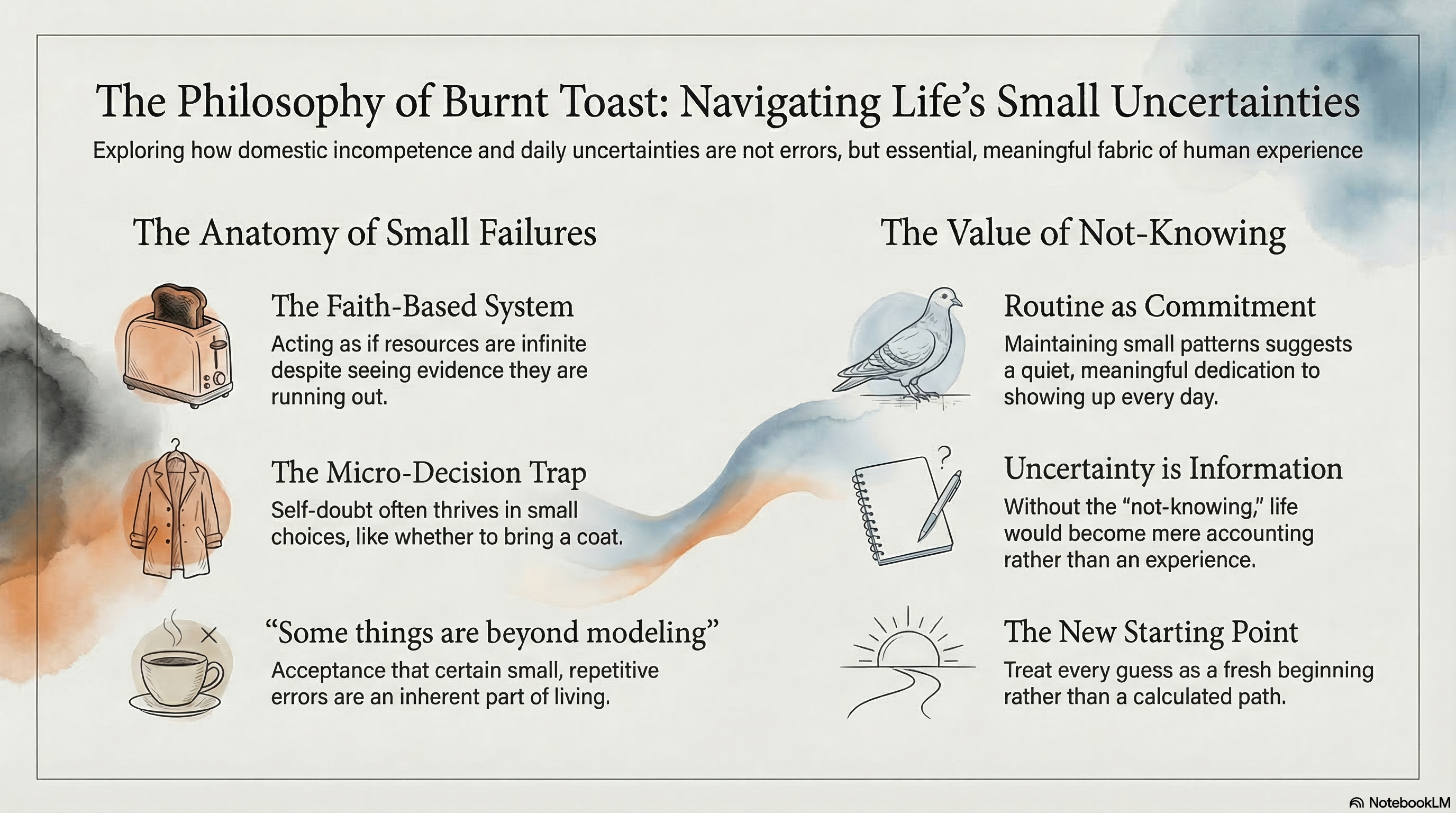
The smell hit me before the alarm did. Burnt toast — not catastrophically burnt, just the low-grade, slightly accusatory kind that means you walked away for thirty seconds too long. I stood in the kitchen in yesterday's socks, staring at two dark rectangles as if they owed me an explanation. They didn't, of course. They were just toast.
That's how most Sundays begin. Not with drama, but with something small going slightly, stubbornly wrong.
I scraped the toast over the sink — an optimistic gesture, really, as though removing the char would restore the bread to something edible and morally neutral. The kitchen smelled like a mild failure. Outside, the neighbor's dog was already mid-monologue, narrating the arrival of the garbage truck with the urgency of someone filing a formal complaint. I found myself listening. Nodding, almost. Fair enough, I thought. Sundays do deserve a warning.
My coffee went cold while I was doing this. Obviously.
There's a particular kind of domestic incompetence that isn't laziness, exactly — it's more like a faith-based system. You believe the toast will not burn. You believe the coffee will stay warm until you're ready for it. You believe the cereal box will not be empty when you reach for it, even though you noticed it was getting light three days ago and made absolutely no adjustments to your behavior. The belief persists. The evidence mounts. You do nothing.
This morning, the cereal box was, in fact, empty. I shook it anyway. Just to confirm. Twice.
By ten o'clock, I had eaten half a banana, reconstituted the cold coffee with a splash of hot water from the kettle — a maneuver I tell myself is acceptable but which I would judge harshly in someone else — and had a brief, inconclusive negotiation with myself about whether I needed a coat. The sky looked ambiguous. Not threatening, not reassuring. The kind of sky that shrugs.
I took the coat.
I was too warm by the time I reached the end of the street.
Small decisions like this are where most of my self-doubt actually lives. Not in the large choices — career, love, where to be and with whom — but in the coat question, the toast question, the cereal question. There's a specific quality of irritation that comes from being wrong about something entirely within your own jurisdiction. Nobody else burned the toast. Nobody held the coat hostage. I just consistently overestimate my ability to read a situation that has been the same situation, more or less, for fifty-odd years.
I quickly drive to the town and then walk to the coffee shop — because, yes, after all that, I still needed a proper coffee — takes me past the dry cleaner, the florist who is always arguing quietly on the phone, and the corner where a very elderly man feeds pigeons every Sunday with the methodical devotion of someone performing a ritual. I don't know his name. I nod. He nods. The pigeons ignore us both. This has happened enough times now that it constitutes a relationship of sorts, or at least an understanding. We are both creatures of pattern. We are both, apparently, Sunday early risers who've made our peace with the situation.
There is something I find quietly affecting about routine, even other people's. It suggests a kind of commitment — to the day, to the birds, to showing up again regardless. Though it's also possible he just likes pigeons and I'm overlaying meaning on a man's breakfast preferences. That seems equally likely.
Inside the coffee shop, a woman at the corner table was on a phone call that was clearly going badly. She wasn't crying. She wasn't shouting. She was doing that contained, over-controlled speaking that is somehow worse — the kind where every word is a small act of will. I didn't mean to notice. I ordered my black coffee and looked at the menu I've had memorized for two years. The barista, who also has the menu memorized and knows I always order the same thing, asked if I wanted anything else with the cheerful patience of someone who has chosen, deliberately, not to find their job absurd. I respected that.
I sat down with my coffee. The woman finished her call. She looked out the window for a moment with an expression I recognized — not grief, not quite, but the face you make when something has just rearranged itself and you haven't caught up yet. Then she went back to her laptop. Life, apparently, does not pause for the rearranging.
I thought about a conversation I'd had last week — an old friend, catching up over food we were both only half-eating, talking about how strange it is that people change and yet somehow remain identifiable as themselves. How you can know someone across twenty years and several versions of their life and still be surprised by them. How the person sitting across from you is both entirely familiar and, occasionally, a stranger wearing a very convincing costume. She laughed at that. So did I. We didn't resolve it. You can't, really.
That's the part I keep turning over. Not the resolution — there isn't one — but the fact that the uncertainty is itself a form of information. If I knew exactly how each day would go, what each conversation would cost or give, the whole enterprise would become something else. Scheduling, maybe. Or accounting. The not-knowing is annoying and it is also, I think, the point.
By mid-afternoon the ambiguous sky had made up its mind and was raining lightly, the way it does when it wants you to know it's serious but doesn't need to prove anything. I had my coat. This felt like a win, though a very modest one — the kind of victory you can't really tell anyone about without them looking at you with gentle concern.
Then, I walked past the florist, who was no longer on the phone and was arranging dahlias in the window with the focused expression of someone doing exactly the right thing at the right moment. I envied that briefly. Then I thought: well, she probably burned her toast too. Maybe she also shook the empty cereal box. Maybe her sky was also ambiguous this morning, and she also guessed wrong about the coat, and here she is anyway, arranging dahlias.
That felt right. Not comforting exactly, but accurate.
Here's what I've concluded, though conclusion feels too confident a word: every day is a small sequence of states. This one follows that one. Yesterday nudges today. You make a guess — coat or no coat, this conversation or that silence, whether to say the thing or hold it — and the guess becomes the new starting point. You don't calculate the whole path from here to wherever you're going. You can't. You just move, one imperfect step at a time, carrying the immediate past and a reasonable amount of uncertainty.
And tomorrow I will probably forget to watch the toast again. Which is fine. Some things are beyond modeling.